John
Greer "the immigrant" Family
Ireland or Scotland and South
Carolina
m. unknown*
b.
d.
buried:
her father:(?)* her mother: (?)*
| Possible children based on land grant of 1764 | |||
|---|---|---|---|
| Joseph Greer * | b. ? probably in Ireland | d. before 1783 S. C. |
m. |
| John Greer JR. | b.? probably in Ireland | d. | m. |
| Andrew Greer JR. | b. ? probably in Ireland | d. | m. |
| Jane Greer # | b. ? probably in Ireland | d. | m. John McCrary Sr.# |
| Sarah Greer | b.? probably in Ireland | d. | m. |
I assume that John Greer was born before
1714 due to the fact that he filed for a land grant in 1737 and
should have been at least twenty-one. With the reference to the
name of the community in South Carolina that they lived in being
"Belfast" it wouldn't surprise me that John Greer and his sons
or possible brothers, Joseph, Andrew, were coming from Northern
Ireland. When listed as protestants from Ireland this gives us
clue as to other origins of the family. Greer is not a listed
Irish clan name but Grier is an name in Scotland associated with
the McGregor clan. I suspect that earlier history of this family
will lead back to Scotland and the growth of the Presbyterian
Church through the Covenanter
Risings. They could easily have been forced out of
Scotland for their beliefs and lived in Ireland for a couple of
generations before immigrating to the Colonies. These Scottish
immigrants in Ireland have been said to be "Scotch-Irish".
The Greer family name is a pseudonym for
the MacGregor clan or son of Gregor. The Gregor clan had a
long and troubled history in Scotland "located in Glenorchy as
early as the reign of Malcom Caumore (1057-1093)".
Although having a large territory that they used to raise cattle
they became dispossessed by the various Campbell noblemen and
became outlaws. They made raids on the families that had
dispossessed them. "In 1488, soon after the youthful
James IV, had ascended the throne which the murder of his father
had rendered vacant, an act was passed "for staunching of thriftreif and other and other
enormitied throw all the realme..." The enforcers were
the Campbell of Glenorchy, Neill Stewart of Frotingall, and Ewin
Campbell of Strachur. Things didn't get any better for the
Gregors over the next two hundred years. At best they were serfs
on the land and at worst they were hunted and at various times
in full on war. "Rob Roy" MacGregor is a good
example of one who had tended cattle, took out loans that he
couldn't repay, eventually he turned to robbery. He is known as
the Robin Hood of Scotland for robbing the rent collectors of
the Campbells and giving the money back to the people.
[Anderson p. 734] "When the MacGregor trapped and
slaughtered the Colquhouns at Glen Fruin on 7 February 1603 , an
Act was promptly passed by the Privy Council, on 3 April of the
same year, proscribing the MacGregor name. 'Proscribe'
sounds innocent, but what it actually meant was that anybody
bearing the name MacGregor could be beaten up, robbed and killed
by anybody who felt like it, with total impunity. Nobody with
the name MacGregor could be baptized, married or buried by the
Church, nor could they hear Mass or receive communion. "
[McKinnon page 181] Because the name MacGregor was
expressly abolished, it made living in Scotland difficult for
any MacGregor and many immigrated shortly after this
prohibition, usually changing their names to something more
acceptable such as Greer.
An example of this comes from another family's document that is only superficially related to our family but may be somewhat similar to my projection of ancestry. It comes from a Revolutionary Claim from Robert Long who had served under Capt. Joseph Greer.
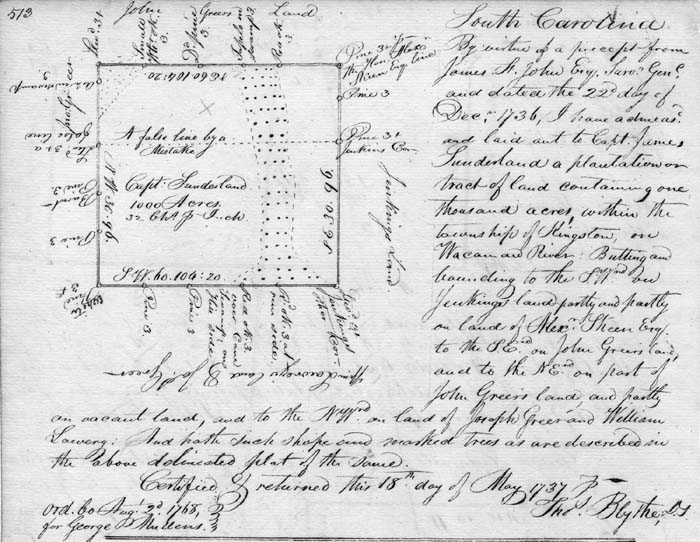
1737 - John Greer is already listed on
early land maps of South Carolina in 1737. He and Joseph
Greer (upside down) are listed as a neighbors to property filed
by James McCreary for fifty acres on Feb. 21st and also to the
1000 acres filed for by Capt. James Sunderland in Kingston
township on May 18th. The following drawing comes from
South Carolina archives. Note John Greer's land at the top
of the page by the scale of the name he may own a parcel of land
the size of Sunderland although no land record can be found to
give either John or Joseph connected with these parcels, a scale
or date before Sunderland's record in 1737. [S213184:
Colonial Plat Books, South Carolina Archives]
1755 - From Amy McCrary who found these land records in the
South Carolina Archives in unrecorded claims. These records do
not seem to be the same 100 acres that is granted in 1764 in the
Council Journal. The original petition was written on July 4th
1755.
On 5 Aug 1755 John Greer petitioned the Gov. of SC for 100 acres
for two persons in his family for whom he never had any warrant
of survey or Grant of land in the Province on Duncan Creek near
John McCrarey. Since this is several years earlier than is
listed for the John Greer and family of 1864, I propose that
John Greer came and established himself in the colonies and then
went back to Ireland and picked up the rest of his family. I am
attempting to get a copy of this land record which was recorded
on the same day as McCrarey. [Council Journal p.290] [records of
Amy McCrary]
There is a drawing of the plat and on the reverse side of the Platt is written: John McCrarey Platt 100 acres in the Fork----Warrant Aug 5 1755 ---Surveyed July 6 1756 by Jo. Curry....entered Oct 16 1756 .... Deld. to Recorded Book folio......[later writing] Recorded in State Records Misc. Plats. p.92 (and in pencil......."not recorded". This record establishes John's presence in SC at that date and he later had other recorded grants of land on Duncan's Cr. "Mr. Risher Fairey who was a compiler of the Unrecorded Platt portion of the Alphabetical Index at the SC Archives told me that the two persons in John McCrarey's family would have been his wife and a child, or two children and that John had undoubtedly already procured an earlier grant." [records and comments of Amy McCray]
1764 - John Greer is listed as immigrated
to South Carolina from Ireland on 8 Jan 1764. He arrived on the
ship "Folk" with Captain William Henry. [So. Caro. Council
Journal, #30. pp 22-31, Meeting of 24 Jan 1764, as listed by
Janice Craft p.3] This particular John Greer may be an
additional Greer. It is unknown whether this person is the same
or related Greer. According to the following document and its
date this John may have come with his whole family and does fit
the known family history. Since John and Joseph had
already been here for about seventeen years, this John Greer may
be the son of the earlier John who immigrated later.
Jan. 24, 1764 - John Greer, John Greer Jr., Joseph Greer, Andrew, Jane Greer, Sarah Greer each petitioned for land as immigrants from Ireland. All were protestants. We assume that these five Greer folks were all over 21 years old just to be allowed to apply for land. It is still a question in my mind about whether the women listed here were single, wives of Greer men or widows of Greer men. The McCrary researchers support with documentation that Jane Greer marries John McCreary .
Grants located at Boonesbough and Belfast,
S. C.
One east of "Due West, SC" near Laurens Co.[Craft 3]
JOHN GREER-150 acres
JOSEPH GREER-100
JOHN GREER, JR-100
ANDREW GREER-100
JANE GREER-100
SARAH GREER-100 ...
"The Petitioners were respectively sworn to their family
rights and produced Certificates under the hands of Ministers
and Church Wardens of Dissenting Ministers and Elders of
Congregation in Ireland of their being Protestants and sett
forth that they were arrived in this Province upon the
encouragement and bounty allowed by the Act of the General
Assembly of this Province passed 25 July 1761 and therefore
humbly prayed an Order to the public Treasurer to pay the said
Bounties and It appearing that they severally paid for their
respective passages. Ordered that the Clerk do grant them
Certificates to the Public Treasurer to pay the said Bounties
and that the Secretary do prepare Warrant of Survey to the
Surveyor General to cause the land prayed for to be run out to
the petitioners in Boonesborough or ____ (Belfast?) Township."
Revill, J. (1974). Protestant Immigrants to SC 1763-1773.
[records of John Harrison on Genforum.com #3282]
Laurens County Deed Book lists these
transfer of title to land on Duncan Creek.
John Greer, Sr, land to James Greer, 150 & 150 acred, located Duncan's Creek. [Deed Book B, p 453]
Robert Greer to Joseph Greer, 60 and 200 acres on Duncan's Creek. [Deed Book G, p 608 & 617]
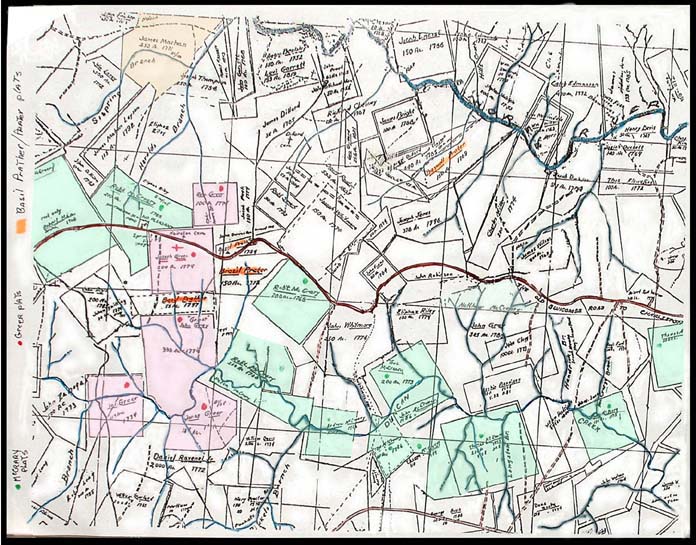
There are twelve Greer men listed in the South Carolina Roster of soldiers in the militia during the War for Independence. We are uncertain if any of these are related to our family.
1790- There are six Greer heads-of-family in Laurens County but Joseph Greer was the only one who had two males over 16. [Craft]
1790 - Head of families lists Ninety Six Dist. which included at present time the area of Laurens, Pendleton, Greenville, Abbeville, Edgefield, Newberry, Spartanburg and Union Counties. Note the spelling of John and Joseph as Greir not Greer.
|
|
|
free males 16+ yrs |
free males -16 | females | other | slaves |
| p. 74 Laurens | Greir, Joseph | 2 | 3 | 4 | _ | _ |
| |
Greir, John | 1 | 3 | 5 | _ | _ |
| |
Greir, Richard | 1 | 2 | 3 | _ | _ |
| p. 75 Laurens | Greer, Robert | 1 | 1 | 2 | _ | _ |
| p. 83, Pendleton | Greer, James | 2 | 1 | 4 | _ | 1 |
| Greer, Equilla | 2 | 4 | 2 | _ | 5 | |
| Greer, Solomon | 2 | - | 4 | _ | 1 | |
| p. 84 Pendleton | Greer, John | 2 | 4 | 5 | _ | _ |
| Greer, James | 1 | 5 | 2 | _ | _ | |
| p. 83 | Burns, Alex. | 1 | 3 | 6 | _ | _ |
| p. 58 Abbeville | Jones, Adam Cr. Esq. | 3 | 1 | 1 | _ | 25 |
1799 - Joseph Greer bought from Robert
Greer 200 acres on Duncan Creek. Robert Greer Adm. of estate of
Joseph Greer, Deceased. Located between Enoree and Duncan's
Creek.
Bounded by lands belonging to John Greer. witnesses: John D.
Kern, Samuel McConahey [Laurens Co., Deed Book G, p 617. 15 June
1799]
1803 - Robert Greer sells 20 and 200 acres to Joseph Greer on Duncan Creek. This could only be to Joseph Greer Jr. born in 1770, his father died before 1799. This is probably part of the property that was originally own by John Greer "the immigrant". [Laurens Co., Deed Book G, p 608 and p 617]
Source:


All information and
photos included within these pages was developed by
the help of hundreds of researchers. The information
here is for the express purpose of personal
genealogical research and is freely offered as long
as this site is listed as a source. It may not be
included or used for any commercial purpose or
included in any commercial site without the express
permission of Elroy Christenson. Copyright Elroy
Christenson 1998-2012.